Africa & Development · Published 2025-04-28
🥑 The Great Avocado Crisis: Can Kenya Save Its Green Gold?
Why Kenya's once-thriving avocado export is on the brink—and how to turn the tide before it's too late Kenya was once poised to become the “avocado capital of Africa,” riding high on booming exports to Europe, the Middle East, and Asia.…
Why Kenya's once-thriving avocado export is on the brink—and how to turn the tide before it's too late
Kenya was once poised to become the “avocado capital of Africa,” riding high on booming exports to Europe, the Middle East, and Asia. But today, the sector stands on a precipice. Behind the headlines of rising exports lies a painful truth: mounting export costs, quality issues, and regulatory chaos threaten to crush the very farmers and exporters that powered this success.
As countries like Peru, Mexico, and South Africa race ahead, Kenya’s avocado industry faces a quiet but devastating collapse unless urgent action is taken.
📉 The Crisis Unpeeled: What’s Going Wrong?
Kenya's avocado exports rose from $90 million in 2019 to over $147 million in 2023. However, recent challenges could reverse these gains. Let’s explore the culprits behind this impending downfall:
1. 🚫 Unbearable Export Costs
The phytosanitary certification fee has jumped from KSh 1,500 to KSh 5,000 per consignment, hurting small exporters the most. This 230% increase makes Kenyan avocados less competitive in a global market where margins are already tight.
2. 🧾 Regulatory Red Tape & Duplication
Exporters must deal with overlapping inspections from KEPHIS, the Horticultural Crops Directorate, and Plant Inspectorate Services, often duplicating processes and delaying shipments. Every delay increases the risk of fruit spoilage and shipment rejection.
3. 🥀 Substandard Fruit Quality
From immature fruit harvesting to poor agronomic practices, quality control starts at the farm—but many farmers lack the training, tools, and incentives to meet international standards. The result? Rejections in high-value markets, especially Europe, where even one intercepted shipment can cost millions in lost contracts and reputation.
4. 🏁 Global Competition Leaves Kenya Behind
Countries like Peru and Mexico have perfected the export game:
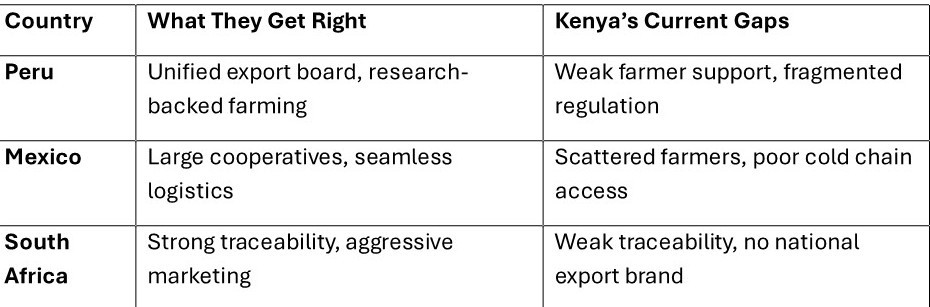
They have state-funded avocado boards.
They support traceability systems, coordinated harvesting calendars, and cold chain logistics.
Their farmers are organized into cooperatives that access agronomic training and market insights.
Kenya, on the other hand, still struggles with fragmented value chains and limited farmer education.
🔧 The Path Forward: Reclaiming the Avocado Advantage
Kenya can still rescue its avocado sector. But it will require coordinated reform, targeted investments, and a shift in mindset—from chasing volume to ensuring value and quality.
✅ Recovery Plan Checklist:
1. 🧑🏽🌾 Farmer Education & Training
Establish county-level agronomy hubs for avocado.
Provide free or subsidized training on fruit maturity, grading, post-harvest handling, and market standards.
Disseminate real-time updates on market prices and harvest windows.
2. 🏢 Simplify Export Bureaucracy
Create a one-stop inspection window for exporters.
Digitize all phytosanitary documentation and remove overlaps among KEPHIS, HCD, and others.
Consider a waiver or subsidy for smallholder exporters on inspection fees.
3. 📦 Cold Chain & Logistics Investment
Expand access to affordable packhouses, especially in Murang’a, Kiambu, Meru, and Kisii.
Develop public-private partnerships (PPPs) to establish rural cold storage and collection centers.
4. 🤝 Farmer Cooperatives & Export Consortia
Encourage the formation of export-oriented cooperatives.
Link smallholder farmers to exporters through aggregation models with shared standards and traceability.
5. 🌐 Market Diversification & Branding
Build a national “Kenya Avocado” brand, like Peru’s "Superfoods Peru."
Focus on high-potential markets in China, UAE, and India.
Invest in compliance with specific country requirements—such as cold treatment for Chinese exports.
💡 Why Others Succeed (and We Fail): A Global Comparison
🔁 Conclusion: A Call to Action for Kenya’s Avocado Future
Kenya has the climate, the demand, and the entrepreneurial spirit to dominate the avocado trade. But without urgent reforms, we may become a cautionary tale—another country that squandered a golden opportunity.
Let’s not just talk about avocado potential. Let’s invest in it.
This is a wake-up call for:
The Ministry of Agriculture
County governments
Development partners
Exporters and aggregators
Farmer organizations
The green gold of Kenya can shine again—if we act now.
📢 Let’s Keep the Conversation Going
Tag a farmer, exporter, policymaker, or NGO leader and ask:
👉 Are we really doing enough to secure Kenya’s avocado future?
About the Author
Dr. Julius Kirimi Sindi is a global expert in research funding, policy impact, and donor relations. With extensive experience in analyzing philanthropy, business, and science funding, Dr. Sindi fosters sustainable and inclusive research ecosystems. He has facilitated international business relationships across Africa, Europe, and Asia. His upcoming book, "The Blueprint of Life Well Lived," explores successful strategies for navigating complex business environments while achieving sustainable growth.
Join the conversation
What did this article make you think about?
Thoughtful questions, reflections and respectful disagreement are welcome. First-time contributions are reviewed before publication.